What Tuesday's results did to the red-state data center playbook
We've spent years working on how data centers fit into the communities that host them, starting well before most of those communities knew what a data center was. Along the way we heard many points of view.
Some of the people we met were proactively passionate about being good neighbors. One project piped its waste heat into greenhouses to grow produce in food deserts and invested in education for everyone in the surrounding opportunity zones.
We also encountered a different approach: lobbyists whose goal was to make a data center build a right, the same way the YIMBY and abundance movements want affordable housing approvals freed from red tape. Ohio's right-to-compute bill is one such effort, having sat in the state House since 2025, with others proposed across the nation.
This second approach treats community opinion as a fly to be swatted. And as of November 3, the fly is swatting back
There are three direct repudiations:
- Ballot measures directly blocking data centers,
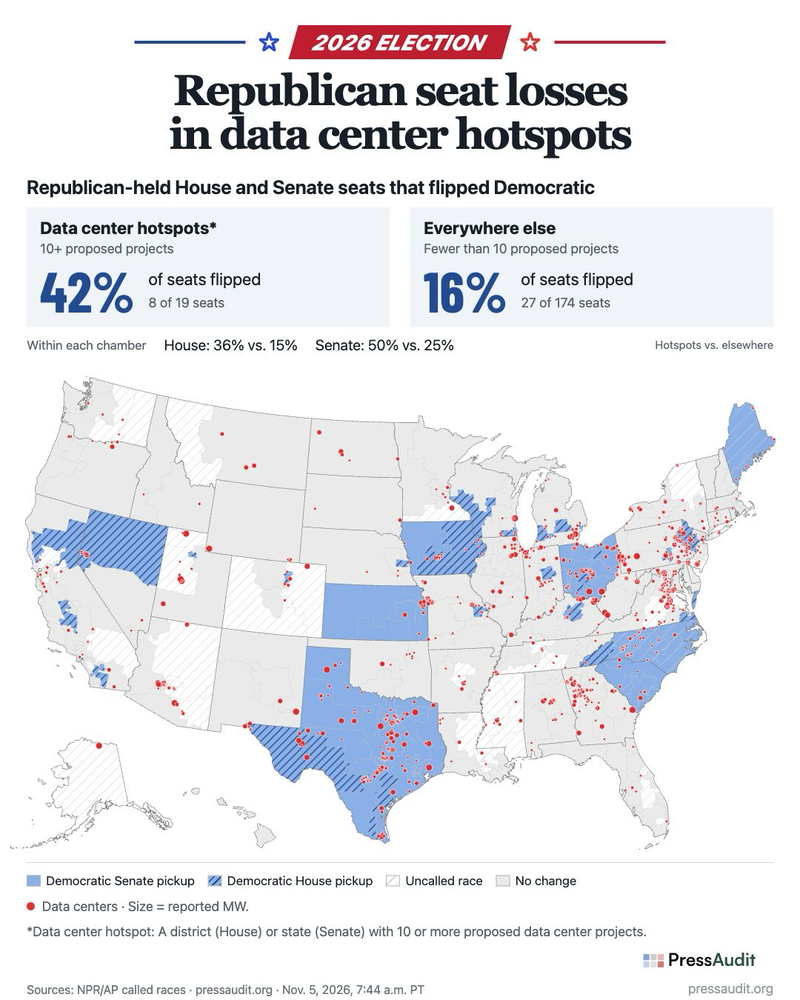
- Blue waves in fastest-growing compute hub states tied to moratorium pledges, and
- A strong correlation between data center builds and the intensity of that wave, likely spooking surviving incumbents.
If overriding public discontent was your route to ensuring your build launched, you need a plan B. Fast. Luckily we have five of them, so if you’re on edge about the future of your project, give us a call.
The direct ballots were crystal clear
On Tuesday, voters in ten states decided 41 local data center measures. By Wednesday morning 38 had been called, and voters limited or blocked development in 37 of them. Ohio supplied 21 of the 41. At least 14 Ohio towns passed bans or new limits, ten of them outright bans on large facilities, and in Wilmington about 80% of voters rejected four rezonings tied to a planned data center. In Urbana, voters recalled the mayor over the city's handling of a data center project. These are unofficial tallies until counties certify, so the direction is the reliable part.
Traditional lobbying and dealmaking is no longer a backstop
The ballot measures are just part of the story. An equally seismic change for many projects ready to break ground is who now sits in the governor's office and/or legislature.
Texas holds the largest share of the industry's bet. Baxtel's October count puts it at 32% of all US data center capacity under construction, though JLL's year-end 2025 figure was closer to a fifth, and the two count differently. Either way, Texas just elected Democrat Gina Hinojosa governor, and the lieutenant governor and attorney general offices flipped as well. Hinojosa campaigned on a moratorium on new data centers and their approvals until lawmakers pass protections. Abbott had already paused grid approvals for new data centers in August, so the insulation was thinning before the votes were counted.
Ohio ranks fifth nationally for data center projects. It elected Democrat Amy Acton governor, about 52% to 45% over Vivek Ramaswamy. In Georgia, Democrats won the governor's race and both Public Service Commission seats, flipping the commission for the first time in decades. Governor-elect Keisha Lance Bottoms has called for a year-long ban on data center construction.
Even red-state survivors are looking over their shoulders
It's not as though every red state turned blue last night. But the assumption that someone at the capitol can overrule the neighbors is no longer safe. If South Carolina and maybe even Mississippi can elect Democratic senators in 2026, what other locales will be in play in 2028 or 2030?
Data centers are not merely a side effect of this new political insecurity; they’re also a feedback loop. In places where building activity is heaviest, Republicans lost seats at a 2.6x higher rates. Regardless of whether the correlation implies causation, politicians whose lifetime sinecures are suddenly looking precarious will read the tea leaves and jettison politically dangerous projects at a faster rate.
A deal cut with a governor lasts as long as the governor does, and tax breaks, grid priority and permitting are exactly the things a new administration can revisit. Anyone who built a plan around a business-friendly statehouse ignoring public opinion needs a new plan.
So now what?
We're working on five interlinked paths for data centers that want to be part of their community, from the simplest to the most ambitious. Each deserves its own article, coming soon, so take these as teasers:
Education. The gamble is that facts win. Some of the fear is silly in a way that deserves patience: there are people who, with no hyperbole or humor, believe Lake Michigan will be drained if a data center goes up nearby. But a July Reuters survey found only 14% of American adults would support a data center in their community, and partisanship makes this path, if pursued alone, as quixotic as relying on fact-checkers to resolve culture wars.
Enthusiastic consent. A transparent, enforceable contract with the host community, with terms that can't be quietly renegotiated once the concrete is poured, and a record that planning boards, neighbors and developers can all point to. Blockchain is a good fit here because it makes the record tamper-evident.
Conscious Compute. B Lab created the blueprint for what a corporation needs to do to maintain a social license to operate: legally pledge to work for stakeholders other than just investors, then stand up to outside audit. Conscious Compute certification applies the same logic to data centers: ground-up design for fit with all stakeholders, not just uptime and cost.
Deeper integration. Waste heat for homes and greenhouses, local hiring in the opportunity zones around the site, training for residents when on-site jobs aren't possible, true community centers driving commerce, travel, and civic life. None of it was expensive relative to the bill for GPUs. It just wasn't the default anyone pursued. We’re working on projects that are town-defining and will be a blueprint for full community integration.
Universal basic income, or better, universal basic equity through tokenization. Give every household in the host community a dividend, and eventually a tokenized share of the facility next door. Even the President urged data center companies to pay host communities a dividend last month, though nothing enforceable exists yet. Whoever builds the first real version could change the conversation in the same way the oil business is viewed differently in Norway than it is in the US.
In the meantime, if your path to breaking ground ran through government officials who are packing up their offices, give us a shout about designing a new plan. We've been preparing for this moment.
