
Stablecoins can reduce cross-border payment costs or delivery times on some routes, but the result depends on funding, currency conversion, provider controls and recipient payout. A useful stablecoin vs bank transfer comparison measures the sender's total debit and the recipient's net usable funds. Blockchain confirmation alone doesn't establish that a vendor has spendable money in its bank account.
For US finance teams, the practical question is whether a different route improves a specific payment. For stablecoin cross-border payments, a supplier that accepts digital dollars presents a different problem from one that needs local currency deposited into a bank.
Start with the invoice currency, destination country and required arrival time. Then compare your existing bank or payment provider with a stablecoin route using the same starting and finishing points.
Key takeaways:
- Compare total sender cost and net recipient funds, including conversion and payout.
- Separate blockchain confirmation from spendable bank funds.
- Verify token support, provider permissions, custody and payment controls.
- Pilot a defined route before changing routine vendor payments.
How do stablecoin payments work for businesses?
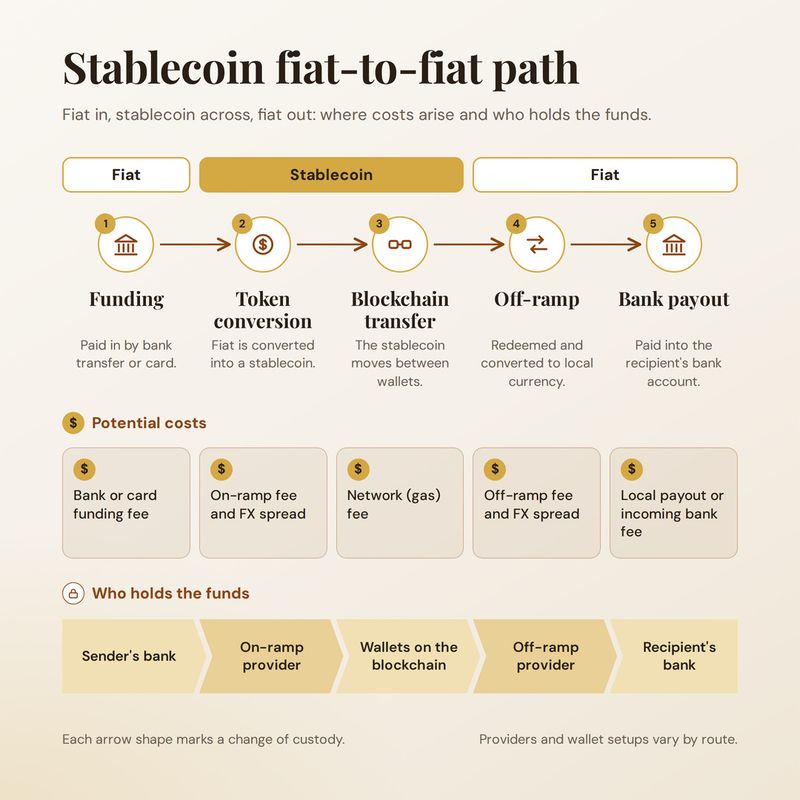
Businesses can fund a provider with conventional currency, convert it into a supported stablecoin, transfer that token over a supported blockchain, and arrange conversion into the recipient's required currency. The recipient may instead accept tokens directly. Each step has its own operator, conditions and costs, so wallet delivery and completed bank payout are different outcomes.
A fiat-to-fiat route, starting and ending in government-issued currency, has five steps:
- On-ramp: Your bank sends funds to a provider that handles conversion. That provider controls the funded account under its terms.
- Token selection: Confirm the exact token and network accepted by both providers.
- Blockchain movement: Your business controls signing keys in self-custody; a custodian controls transfers in a hosted arrangement.
- Off-ramp: The receiving provider takes custody of the tokens and handles sale or redemption.
- Bank payout: The payout provider sends currency to the recipient's bank, which credits the recipient under its account rules.
Circle's USDC terms require an eligible Circle Mint account in good standing for direct redemption. Holding USDC doesn't automatically provide that access. USDT has separate Tether terms and supported protocols. Never assume support for one token or network establishes support for another.
Stablecoin vs wire transfer: where does the money go?
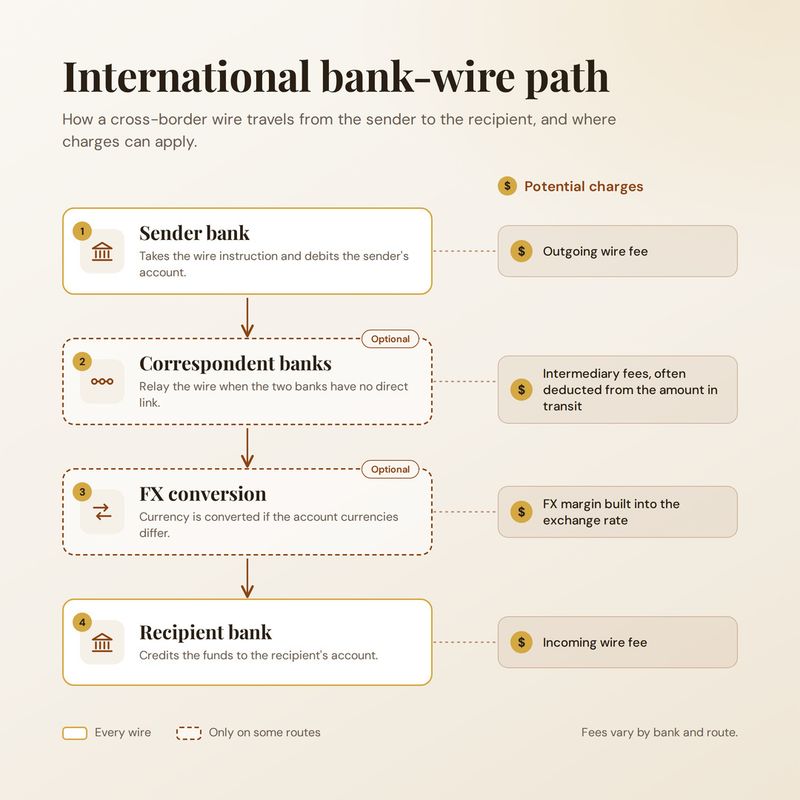
An international wire can involve a sending-bank fee, intermediary or correspondent charges, a receiving-bank charge and a foreign exchange (FX) spread. Ask which charges the sender pays and which reduce the recipient's credit.
A stablecoin route can involve funding charges, purchase or conversion costs, blockchain network fees, provider charges, redemption costs and local payout fees. Stablecoin payment fees shown by a provider, plus stablecoin transaction fees shown by a blockchain, are only part of the total.
Request an itemized quote, but don't add an FX spread twice if the quoted conversion rate already includes it. Likewise, establish whether provider pricing includes network and payout charges.
Swift provides financial messaging. It isn't itself the bank holding or transferring your balance. A wire is a type of bank transfer; Automated Clearing House (ACH) payments, domestic wires and international wires are different products. This is part of the broader stablecoin vs traditional payments comparison, where the relevant unit is the full payment route rather than a single network.
RampRate's discussion of the tollbooth problem in payments examines how payment access and pricing affect users. Its authors, Tony Greenberg and Alex Veytsel, write that “fees should scale with cost, not with market power.”
Stablecoin vs bank transfer: can stablecoins offer lower costs and faster settlement?
Lower costs and faster completion are possible, but neither follows automatically from using a blockchain. Compare equivalent currency outcomes, timing commitments and controls.
| Factor | US domestic ACH | US domestic wire | International bank wire | Stablecoin payment with fiat payout |
|---|---|---|---|---|
| Cost components | Bank or provider charges | Sending and possible receiving fees | Sending, intermediary, receiving and FX charges | Funding, conversion, network, provider and payout charges |
| Completion milestone | Recipient funds available under applicable rules | Bank settlement plus recipient credit | Spendable recipient bank funds | Spendable recipient bank funds after conversion |
| Operating availability | Banking-day settlement windows | Service hours and bank cutoffs | Route, bank and local-system schedules | Blockchain availability plus provider and payout schedules |
| FX | None for a domestic dollar payment | None for a domestic dollar payment | Required when currencies differ | Required when funding or payout currency differs |
| Recovery options | Rule-bound returns and limited reversals | Recall request; recovery not guaranteed | Recall request; recovery not guaranteed | Provider-assisted recovery may be limited |
| Sender responsibilities | Authorization and account validation | Verify beneficiary and instructions | Verify beneficiary, currency and charge allocation | Also verify token, network, custody and payout |
| Suitable use cases | Routine US payments | Time-sensitive domestic payments | Overseas recipients requiring bank deposits | Supported cross-border routes with a tested payout |
Sources and limits: Nacha documents ACH timing and reversal rules. The Federal Reserve describes Fedwire settlement as final and irrevocable once processed. Circle's terms govern its token and services, not every stablecoin provider. Domestic methods provide context, not equivalent alternatives for every international destination. Fees require account-specific quotes.
Are stablecoins cheaper than bank transfers?
Stablecoins can be cheaper when the complete route costs less for the same recipient outcome. Low blockchain fees don't prove that result. Funding, provider charges, currency conversion and local payout can change the comparison. Request matched quotes showing the total amount debited from your account and the net currency available to your recipient.
Use either a fixed sender budget or a fixed recipient amount consistently. Record the currency pair, direction, payment size, funding method, provider, pricing tier, quote timestamp and recipient endpoint.
Comparable executable quotes were unavailable for this article. These are quote-request scenarios, not measured prices or savings:
| Payment size | Evaluation |
|---|---|
| $10,000 | Test whether fixed charges and setup effort outweigh any quoted advantage, especially for occasional payments. |
| $50,000 | Compare destination FX, net bank credit, payout timing and any charges deducted after submission. |
| $100,000 | Confirm executable liquidity, transaction limits, approval requirements and whether the quoted rate covers the full amount. |
For every size, ask providers to identify exclusions and quote expiry. An attractive estimate that cannot be executed for your destination isn't a usable comparison.
Are stablecoins faster than bank transfers?
Stablecoins can move between supported wallets before a conventional payment reaches its recipient, but fiat payout can add processing time. Bank transfers also vary: some domestic services settle immediately, while international routes depend on the institutions involved. Compare elapsed time from the same funding event to the recipient's ability to spend the required currency.
Record five milestones: payment submission, network transmission, blockchain confirmation or finality where applicable, provider credit, and spendable bank funds. Ask what each provider's “settled” notification actually means. That is the practical meaning of stablecoin settlement for a finance team.
Swift's current explanatory page reports that over 90% of payments reach the beneficiary bank within one hour. This is provider-reported network performance, not a promise of recipient account credit. The page doesn't specify a measurement window or payment-size band.
Eligible US domestic payments through participating institutions can use FedNow, designed for continuous processing, including weekends and holidays. It isn't a universal cross-border substitute.
Reliable earlier access can reduce the cash a recipient needs while waiting for payment. Assess that benefit against any prefunding your business must maintain with the provider.
What risks, compliance and accounting issues matter?
Review issuer reserves and redemption rights separately from the payment provider's financial condition. Determine who holds funds, who can freeze transfers, what happens during an outage and how failed payouts are handled. Circle's terms describe restrictions and suspension rights; don't treat token holdings as an unconditional bank balance.
Require dual approvals, verified beneficiary details, approved wallet addresses and a documented escalation contact. Confirm liquidity and network compatibility before releasing funds.
Payment returns, recalls, fraud recovery and chargebacks are different mechanisms. A return sends funds back under applicable rules. A recall requests recovery of a prior transfer. Fraud recovery depends on circumstances and cooperation. A card-style chargeback isn't an inherent feature of a wire or blockchain transfer.
The GENIUS Act was enacted on July 18, 2025. Its general effective-date formula is the earlier of January 18, 2027, or 120 days after the primary federal payment stablecoin regulators issue final implementing regulations.
Implementation remains rule-specific. The Federal Reserve published proposed issuer rules on September 29, 2026. Treasury's state-certification procedural rule took effect September 30, 2026, with certification submissions subject to paperwork approval. These developments should not be described as a fully implemented issuer framework.
Issuer requirements aren't automatically duties of an ordinary business paying its own supplier. Financial Crimes Enforcement Network (FinCEN) guidance distinguishes own-account users from businesses transmitting value for others. Money-transmitter and Travel Rule requirements depend on activities and applicable rules.
Office of Foreign Assets Control (OFAC) sanctions obligations apply to virtual-currency transactions. Token use doesn't bypass sanctions or other applicable compliance requirements.
Ask accounting and tax advisors how to address asset classification, transaction records, fees, realized gains or losses where applicable, functional currency and reconciliation. Agree on records before the pilot.
This article is general information, not legal, tax or financial advice.
Which option should your business use?
Our editorial view: if recipients need local currency, evaluate the payout step before choosing the transfer technology.
Use this decision checklist:
- Economics: Does a matched quote improve total cost without reducing recipient proceeds?
- Frequency: Does repeat volume justify onboarding, reconciliation and staff time?
- Corridor: Can the provider support the specific origin, destination and currencies?
- Recipient needs: Does the vendor accept the payment method and final currency?
- Operations: Can your team manage approvals, exceptions and accounting records?
- Controls: Are provider permissions, custody arrangements and recovery procedures acceptable?
Consider a pilot when the route is supported and quoted economics or timing justify testing. Define the vendor, transaction cap, approval owners, required payout deadline and stop conditions. Retain the existing payment route as a fallback. For international stablecoin payments, test the full fiat-to-fiat route, not only wallet delivery.
Keep your current bank or payment provider when it already delivers acceptable costs and reliable arrival times, or when stablecoin conversion adds work without a demonstrated benefit. Using both can make sense for businesses with different supplier requirements.
Common mistakes to avoid
- Comparing only network fees: Include funding, conversion, provider and payout charges.
- Ignoring destination FX: A dollar-denominated token doesn't remove a vendor's need for local currency.
- Mismatching endpoints: Don't compare wallet receipt with completed bank payout.
- Skipping provider checks: Verify country coverage, permitted activities, transfer limits and approval controls.
- Mixing payments with yield products: Evaluate lending or investment arrangements separately from payment balances.
Where RampRate fits
RampRate describes Stratum as its enterprise blockchain and stablecoin advisory practice, including reserve structures, tokenization strategy and regulatory guidance. That supports an advisory conversation about fit, including questions around stablecoin payment infrastructure. It doesn't establish that RampRate processes payments or guarantees savings.
Stablecoin payments can reduce costs, settlement delays and some intermediary steps on suitable routes. Conversion and payout services may remain. Frequent payers should choose based on complete cost, usable-funds timing, transparency and controls, especially when evaluating the full stablecoin payment infrastructure behind the transaction.
Share your payment corridors, approximate monthly volume, transaction sizes and current pain points through the RampRate contact form to discuss whether its advisory scope fits your needs.
Frequently asked questions
Are stablecoin payments legal for US businesses?
US businesses can use stablecoins for lawful payments, subject to applicable sanctions, other laws and provider restrictions. Paying your own supplier is different from issuing tokens or transmitting money for others. Confirm the token, provider, destination and business activity with counsel, including applicable GENIUS Act implementation dates.
How much does it cost to send $50,000 internationally with stablecoins vs a wire?
A $50,000 international payment has no single stablecoin or wire price. The total depends on the currency pair, funding method, provider terms, conversion rate and receiving endpoint. Obtain simultaneous executable quotes showing sender debit and recipient net bank funds. This article has no matched quotes establishing a savings amount.
How long does a stablecoin payment take to settle compared to a bank transfer?
Stablecoin payment timing depends on blockchain finality, provider credit and any required bank payout. A wallet transfer can finish before the recipient has spendable local currency. Bank transfer timing also depends on the service and route. Compare the same funding start and recipient endpoint rather than different definitions of settlement.
What do we need in place before paying vendors in USDC?
Paying vendors in USDC requires vendor agreement, compatible token and network support, and an approved custody or payment-provider arrangement. Establish beneficiary verification, dual approvals, transaction limits, accounting records and error procedures. If vendors need bank currency, confirm the off-ramp and payout route before sending a controlled test payment.
Does RampRate process stablecoin payments, or advise on them?
RampRate's published Stratum page describes enterprise blockchain and stablecoin advisory. The reviewed materials don't establish a payment-processing or token-issuing service. Ask RampRate whether the proposed work fits its advisory scope and which responsibilities remain with your payment provider, legal advisors and finance team before agreeing to an engagement.