By Tony Greenberg & Alex Veytsel
Every time money moves from one hand to another, someone decides who gets to move it, how much they pay for the privilege, and how long the money sits in someone else's account before it lands. Nobody votes on those decisions or can appeal them. They just happen, transaction after transaction, and over decades they add up to a value system nobody chose on purpose. That system has a name: payment processing. And it is not a plumbing problem. It is a mirror.
Payment processing isn't a technical function bolted onto the economy. It's the economy's ethos, expressed one transaction at a time.
Look at who gets charged what, who gets blocked, and who profits from the float, and you're looking at a society's real priorities, not its stated ones. The rest of this piece is an argument for what that ethos currently is, why stablecoins are the first real chance to change it, and what RampRate and ImpactSoul are doing about it.
1. The ethos we already have, whether we admit it or not
1.1 The tollbooth
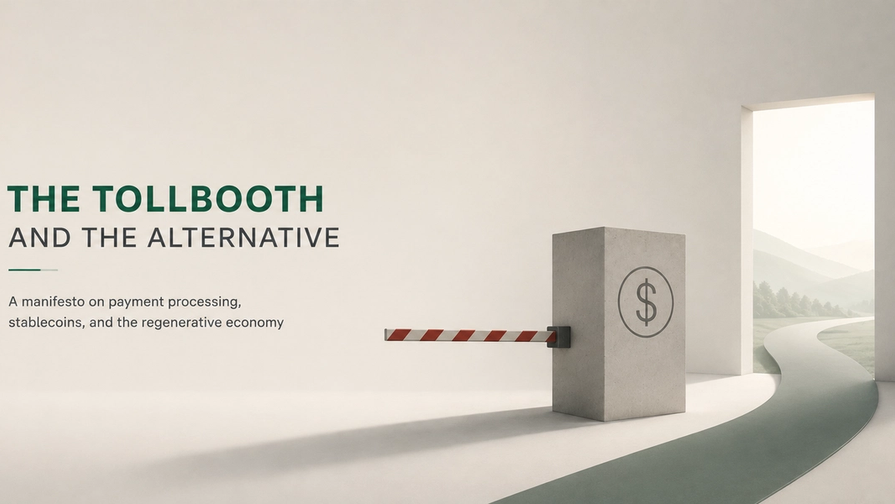
KYC and legal presence exist for legitimate reasons: fraud, money laundering, sanctions enforcement. But somewhere between "legitimate compliance function" and "recurring 2-4% fee on every transaction forever," the function got captured. A bank or processor establishes a regulatory chokepoint once, then collects rent on it indefinitely, long after the actual cost of maintaining that compliance has been recovered many times over. The ethos underneath that arrangement is simple: privileged positions stay privileged through control of access, not through better service or better economics. Once you own the tollbooth, you don't need to compete.

1.2 The unwritten rules
Sanctions lists are at least public. What isn't public is the far larger category of "undesirable": industries, countries, individuals quietly de-risked out of the banking system with no hearing and no appeal. A legal cannabis business, a peptide clinic, a remittance company serving a country with high fraud rates, an adult content platform: all of them can lose their processing access on a compliance officer's judgment call, and none of them get an explanation they can contest. The OCC and FDIC have removed the fig leaf of reputational risk from these decisions, but their priority will likely be those denied service on political or religious grounds, not sector-based ones. It's a system that behaves like Kafka's trial: the rules exist, they bind you, and you're not allowed to read them.

1.3 The 1.3 billion
Then there's the customer who gets excluded for no fault of their own beyond being unprofitable to serve. The World Bank still counts roughly 1.3 billion adults outside the formal financial system, most of them in the developing world, most of them excluded not because they're risky but because the margin on serving them doesn't clear a bank's internal hurdle rate. The ethos here doesn't even require malice. It's colder than that: the person doesn't factor into the decision at all. Only the unit economics do.

1.4 The vig on desperation
The customers who remain inside the system but at its margins pay the most for the privilege. Western Union has charged remittance senders fees that eat 5-7% or more of a transfer, precisely the money that a construction worker in Doha is sending home to family who need every dollar of it. Wire fees, overdraft charges, credit card APRs pushing 30%, payday loans at effective annual rates averaging 391%: the pattern across all of it is that financial services extract the most from the people who have the least room to absorb it. That's not a bug in the pricing model. It's close to the whole business model for a meaningful slice of consumer finance.
Four different mechanisms, one ethos: control access, judge quietly, ignore the unprofitable, and charge the desperate the most. None of it required a villain sitting in a room deciding to be cruel. It just required nobody with the power to change the incentives ever asking whether they should.
2. Stablecoins are a chance to reset that ethos, not a virtue in themselves
It would be convenient to say stablecoins are simply the fix. They aren't, and pretending otherwise is its own kind of dishonesty. Tether became one of the most profitable businesses per employee in financial history through a model that's no less extractive than Western Union: capturing the yield on other people's money and returning none of it. A stablecoin backed by a black box, run for the benefit of whoever controls the reserve, is not a moral upgrade over a correspondent banking network. It's the same ethos wearing a different wrapper.
What's actually new is programmability. For the first time, the person configuring the payment rail gets to decide what backs the token, who receives the yield it generates, and what information travels with the transaction and how traceable it is. Those are no longer fixed by the architecture of the rail itself, the way they were with SWIFT or the ACH network. They're design choices, made by whoever builds and configures the platform. Which means the question worth asking about any given stablecoin isn't "is this decentralized" or "is this compliant," useful as those questions are. It's this: who made the configuration choices, and toward what ethos did they make them?

That's the filter RampRate and ImpactSoul apply to every stablecoin and payment platform we work with, and it's the filter we'd ask anyone reading this to apply too: not whether the technology is impressive, but whether the people holding the configuration keys are pointing it somewhere better than where the old system pointed.
3. What the new ethos actually looks like
3.1 Transparency and traceability first
Privacy coins have a legitimate use case; this isn't an argument against them existing. But the problem we're trying to solve runs in the other direction. When a donor sends money to a cause, we want certainty that it reaches the people it was meant for rather than being skimmed by intermediaries along the way. When someone is promised a reward inside a financial ecosystem, whether that's a loyalty program or a token incentive, we want them to either receive it or be able to see exactly where it went instead. When a transaction sits for three days generating float income for whoever's holding it, we want that float visible, because you cannot fix an extraction you can't see. And when a credit card transaction generates a fee, we want the split visible: how much covers actual fraud losses, how much covers operations, and how much is pure margin. Right now that split is proprietary. It shouldn't be.
3.2 Less extraction, more inclusion, once you can see the numbers
Visibility is the precondition for fairness, not fairness itself, and the second half of the ethos is what you do with what you can now see. Systems should be designed for the people using them, not for whoever happens to control a regulatory chokepoint. Owning KYC infrastructure or a local banking license shouldn't function as a license to tax every transaction that passes through it forever.
That doesn't mean risk-based pricing disappears; it means risk-based pricing has to earn the name. If a sector genuinely generates more fraud, more chargebacks, more frozen funds, then charging it more, or even declining to serve it, is legitimate underwriting. What transparency gives us is the data to tell that apart from a sector being punished for an unwritten moral judgment or a political mood. There's a real difference between a peptide manufacturer running a compliant, tested operation and one selling quack cures with no quality control, and right now most payment processors can't or won't tell the two apart. They just block the category.
Go a step further, and transparency lets you price for social cost, not just financial risk. When a transaction type carries a genuine externality, tobacco, certain forms of high-interest lending, industries with real environmental cost, and government isn't pricing that externality through tax or regulation, a payment system configured by the people funding it can direct a premium toward an actual offset instead of pretending the externality doesn't exist. Nobody is doing this today. It's an available design choice, not a hypothetical.

And underneath all of it: fees should scale with cost, not with market power. If someone is a higher credit risk, charge a higher rate. If they're not, and the higher rate exists only because you're the only processor willing to serve their zip code or their industry, that's a chokepoint tax, not underwriting, dressed up in underwriting's language. Get that right and the same rails should work the same way everywhere: sending a remittance home to a family in Manila should be no harder, and no more expensive, than two coworkers in Chicago splitting a lunch bill on Venmo.
4. What we’re actually building toward
None of the above is worth much as rhetoric if it doesn't translate into a portfolio. Here's where we're putting attention and capital:
- Transparent, programmable, compliant stablecoins: reserve structures you can audit, yield mechanics you can see, and compliance built into the architecture from the start rather than bolted on after a regulator asks a hard question.
- SSID and onramp platforms that share the upside. The KYC function is real work and deserves real compensation, spread across the customer's financial lifecycle rather than collected once at the gate. But it shouldn't come at the cost of leaving the user with no stake in the value their own data and participation created. Compensate the function; don't let it become a toll owned entirely by one side of the transaction.
- Financial inclusion technology at every layer of the stack: stablecoin wallets designed to feel like a bank account for someone who's never trusted crypto, bank accounts that feel like the phone apps people already use every day, investment platforms built for someone without a finance degree, and built without the dodgy high-commission products that tend to fill that gap when nobody more responsible does.
- A philanthropic value chain that doesn't leak. Yield generated along the way should go to the cause, not to the custodians and intermediaries sitting between the donor and the recipient. And where we can, we want to take the fees we earn from more conventional, extractive-model work and redirect them back into that same philanthropic chain, closing a loop instead of just documenting it.
- User-configured fees for social offsets, as described above: a live mechanism, not a white paper concept, for directing part of a transaction fee toward the externality it's connected to.
That's the list as it stands. It's not exhaustive on purpose. If you're reading this and you can see a piece of the payment stack we haven't named, that's the conversation we want to have.
5. This is the bigger picture behind ImpactSoul, not a side project of it
When people ask what ImpactSoul is actually about, the honest answer is that tokenizing a T-Rex skeleton for a good cause was never the point. It was proof that a fundamentally extractive structure, in this case the market for rare physical assets, could be rebuilt with fairness, transparency, and impact at the center instead of bolted on as a marketing layer. Payment processing is the clearest version of that same argument, because everyone touches it and almost nobody examines it. But it's one instance of a pattern that shows up everywhere extraction has become the default setting.
- The attention economy runs the same play: engagement metrics reward whoever is loudest and most addictive, not whoever is doing something worth attention. Shifting that toward causes that deserve eyeballs is the same fight as shifting payment fees toward the people who actually earned the money.
- Online communities run it too: the daily choice between doomscrolling someone else's curated life and actually connecting with people trying to fix something real is an infrastructure choice as much as a personal one, and most of today's platforms are built to make the worse choice easier.
- Governance inside organizations and projects runs it: control usually flows to whoever brought capital, rarely to whoever brought the work, the expertise, or the care that made the thing worth funding in the first place, and reputation-based governance is a real, buildable alternative to that default.
- And AI, the newest and largest version of this pattern, is currently optimized for extraction on both ends: it extracts attention and labor value from users on one side, and it extracts water, power, and compute from communities that host the data centers on the other, with speculative capital racing ahead of any covenant about what those communities get in return. Redesigning that supply chain, so that hosting a data center trades power and water for jobs and clean energy investment rather than for noise and a rising utility bill, is the same problem in a different domain: who captures the value, and who gets to say no.
Payment processing is the loudest, most measurable version of this argument, which is why it's where we're starting the conversation. But it's just one of many systems that ImpactSoul is rebuilding from extractive to regenerative; from cynical to prosocial.
6. Wherever you sit in this, talk to us
None of this works as a thesis alone. It needs people willing to put relationships and capital behind it, which is the part of the stack RampRate has spent the last two years building. We've worked with some of the most respected voices shaping this industry, including the team behind the earliest stablecoins. We've talked with billionaires, the largest family offices, and the advisors managing their DAFs, PPLIs, and impact allocations, people with the financial muscle to back more transparent philanthropic and impact economics and the standing to ask why nobody's built it yet. And we've worked on the ground with dozens of the individual building blocks described above: stablecoin issuers, SSID platforms, inclusion tech, philanthropic rails.
Every piece of this is possible on its own. None of it assembles itself. Where ImpactSoul builds the technology, RampRate builds the connective tissue: the relationships and the shared vision that turn a good idea into a financed one.
- If you're a health product manufacturer who can't find a processor willing to touch your category even though your product is legitimate and your books are clean, we want to hear about it.
- If you're a fintech team building toward the same version of this post-extractive ethos and looking for a partner who understands the compliance, mission, and tech, we may want to team up.
- If you're a philanthropist, foundation, or socially minded enterprise with capital that could sit behind any part of what's described above, from transparent stablecoin infrastructure to a philanthropic value chain that doesn't leak, we'd like to talk about where it fits.
- If you see other ways in which financial flows can become more transparent and less optimized, let's compare notes and build a movement.
The current system runs on an ethos nobody chooses and almost nobody examines. We think that's changeable, and we think the next few years of stablecoin infrastructure are exactly when the choice gets made. RampRate and ImpactSoul want to be in the room when it does.